
The ADA says people with disabilities have rights. Getting them in Georgia is another story.
ADA Matters is a Georgia record, written by a disabled dad, of how the State Bar of Georgia, the City of Brookhaven, GIRMA and Gallagher Bassett, GMA, Georgia POST and the Georgia Insurance Commissioner’s office answered a disabled dad’s requests for ADA access.
 FILED IN FEDERAL COURT, SEPT. 14, 2026
Read the text transcript
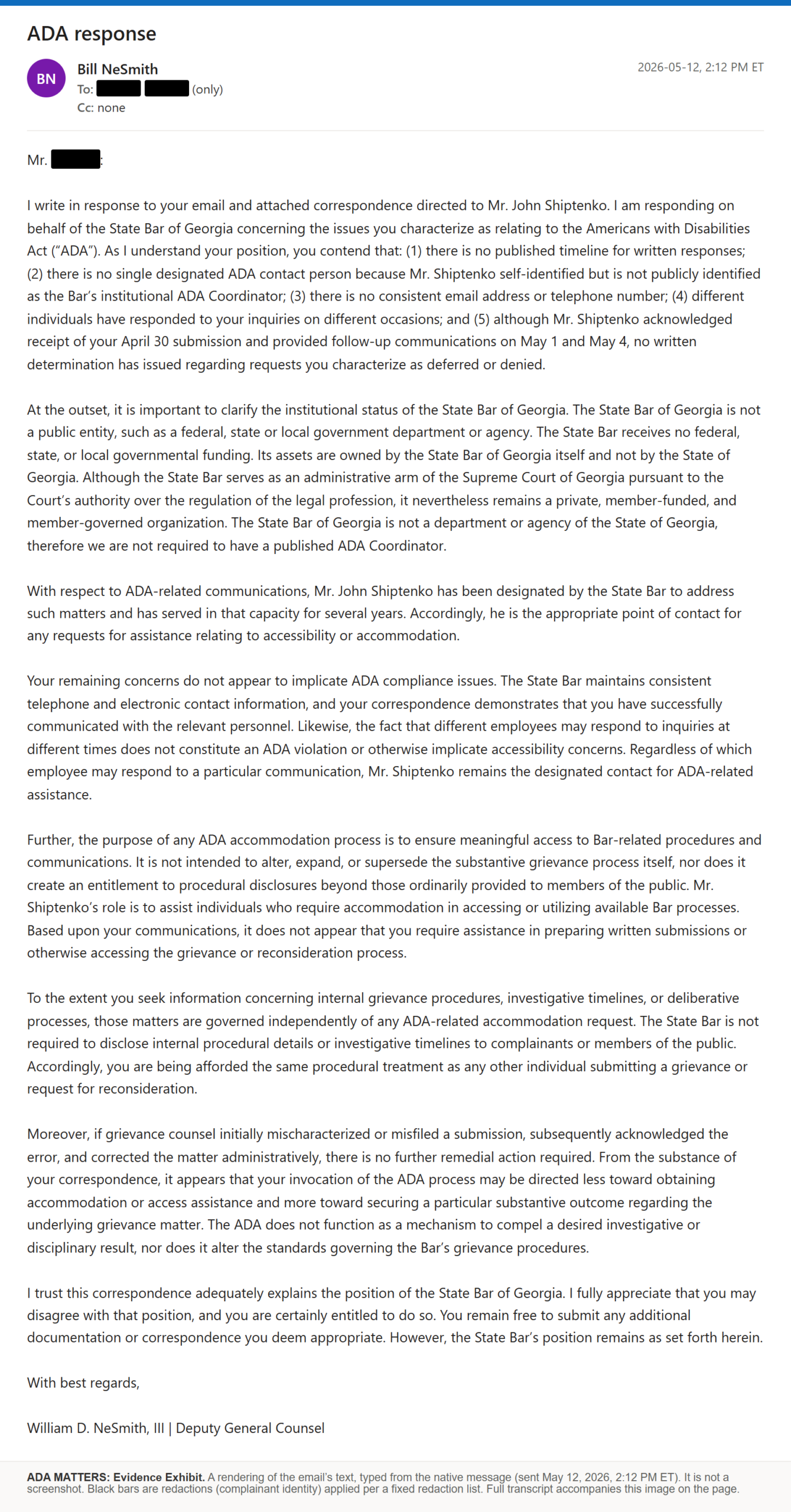
From: Bill NeSmith
To: [my name removed]
Sent: May 12, 2026, 2:12 PM ET
Subject: ADA response
Mr. [my name removed]:
I write in response to your email and attached correspondence directed to Mr. John Shiptenko. I am responding on behalf of the State Bar of Georgia concerning the issues you characterize as relating to the Americans with Disabilities Act (“ADA”). As I understand your position, you contend that: (1) there is no published timeline for written responses; (2) there is no single designated ADA contact person because Mr. Shiptenko self-identified but is not publicly identified as the Bar’s institutional ADA Coordinator; (3) there is no consistent email address or telephone number; (4) different individuals have responded to your inquiries on different occasions; and (5) although Mr. Shiptenko acknowledged receipt of your April 30 submission and provided follow-up communications on May 1 and May 4, no written determination has issued regarding requests you characterize as deferred or denied.
At the outset, it is important to clarify the institutional status of the State Bar of Georgia. The State Bar of Georgia is not a public entity, such as a federal, state or local government department or agency. The State Bar receives no federal, state, or local governmental funding. Its assets are owned by the State Bar of Georgia itself and not by the State of Georgia. Although the State Bar serves as an administrative arm of the Supreme Court of Georgia pursuant to the Court’s authority over the regulation of the legal profession, it nevertheless remains a private, member-funded, and member-governed organization. The State Bar of Georgia is not a department or agency of the State of Georgia, therefore we are not required to have a published ADA Coordinator.
With respect to ADA-related communications, Mr. John Shiptenko has been designated by the State Bar to address such matters and has served in that capacity for several years. Accordingly, he is the appropriate point of contact for any requests for assistance relating to accessibility or accommodation.
Your remaining concerns do not appear to implicate ADA compliance issues. The State Bar maintains consistent telephone and electronic contact information, and your correspondence demonstrates that you have successfully communicated with the relevant personnel. Likewise, the fact that different employees may respond to inquiries at different times does not constitute an ADA violation or otherwise implicate accessibility concerns. Regardless of which employee may respond to a particular communication, Mr. Shiptenko remains the designated contact for ADA-related assistance.
Further, the purpose of any ADA accommodation process is to ensure meaningful access to Bar-related procedures and communications. It is not intended to alter, expand, or supersede the substantive grievance process itself, nor does it create an entitlement to procedural disclosures beyond those ordinarily provided to members of the public. Mr. Shiptenko’s role is to assist individuals who require accommodation in accessing or utilizing available Bar processes. Based upon your communications, it does not appear that you require assistance in preparing written submissions or otherwise accessing the grievance or reconsideration process.
To the extent you seek information concerning internal grievance procedures, investigative timelines, or deliberative processes, those matters are governed independently of any ADA-related accommodation request. The State Bar is not required to disclose internal procedural details or investigative timelines to complainants or members of the public. Accordingly, you are being afforded the same procedural treatment as any other individual submitting a grievance or request for reconsideration.
Moreover, if grievance counsel initially mischaracterized or misfiled a submission, subsequently acknowledged the error, and corrected the matter administratively, there is no further remedial action required. From the substance of your correspondence, it appears that your invocation of the ADA process may be directed less toward obtaining accommodation or access assistance and more toward securing a particular substantive outcome regarding the underlying grievance matter. The ADA does not function as a mechanism to compel a desired investigative or disciplinary result, nor does it alter the standards governing the Bar’s grievance procedures.
I trust this correspondence adequately explains the position of the State Bar of Georgia. I fully appreciate that you may disagree with that position, and you are certainly entitled to do so. You remain free to submit any additional documentation or correspondence you deem appropriate. However, the State Bar’s position remains as set forth herein.
With best regards,
William D. NeSmith, III | Deputy General Counsel
104 Marietta Street NW, Suite 100 | Atlanta, GA 30303
404-527-8728 |
billn@gabar.org
Typed from the native message. Names, my contact details and file numbers are removed and marked in brackets. Nothing else is changed.
The ADA door · as of October 23, 2026
7 Georgia Offices. 0 Working ADA Coordinators Posted When I Asked.
Federal ADA rules tell public offices to name an ADA coordinator and post how to reach that person (28 C.F.R. 35.107). I asked seven Georgia offices for one. Here is who each office oversees, what it had posted, and what it wrote back.
| Georgia offices I asked for an ADA contact | 7 |
| With a working, named ADA coordinator posted on the day I asked | 0 |
| That wrote back the federal rule does not apply | 2 (State Bar of Georgia, GIRMA) |
| Lawyers, peace officers and cities these offices oversee | 56,165 lawyers. More than 40,000 peace officers. 536 cities. |
1. State Bar of Georgia
Oversees: 56,165 Georgia lawyers, as of October 1, 2026 (gabar.org). It runs lawyer discipline for the Supreme Court of Georgia. 108 full time employees (its Annual Report for 2025 to 2026).
ADA coordinator posted when I asked: None named on gabar.org. Its 2026 grievance form gives an unnamed mailbox.
May 12, 2026, William D. NeSmith III, Deputy General Counsel: “we are not required to have a published ADA Coordinator.”
September 22, 2026, John J. Shiptenko, Senior Assistant General Counsel: “I am the State Bar’s ADA Coordinator, and you may continue to send your accommodation requests to me.”
October 8, 2026, John J. Shiptenko: “I am closing this matter, as you have made no request that can properly be classified as a request for an accommodation.”
Not required to publish one. Has one. Closed the matter anyway. Which is it?
2. City of Brookhaven and Brookhaven Police Department
Oversees: Nearly 60,000 residents (2026 City budget) and the Brookhaven Police Department.
ADA coordinator posted when I asked: Lillian Young. She left the City on December 5, 2025. The City’s ADA page still sent complaints to her on March 10, 2026. 95 days.
February 26, 2026, Christian Sigman, City Manager: “Please direct ADA grievances to Linda Warren.”
Today, October 23, 2026, the City’s own website names three people for ADA on two pages: Linda Warren as “ADA Coordinator”, Fire Marshal Joe Burge as “ADA Coordinator” for Title II, and Tom Roberts as “ADA Coordinator” for Title III. It labels the ADA grievance process “Title VII.”
In February: one coordinator who did not work there. In October: three.
Read the latest: City of Brookhaven → · Brookhaven Police Department →
3. GIRMA (Georgia Interlocal Risk Management Agency)
Oversees: Insurance coverage for 402 participants (GMA website), the City of Brookhaven among them.
ADA coordinator posted when I asked: None.
May 1, 2026, James R. Westbury, Jr., outside counsel for GMA and GIRMA: “Contrary to your contention, GIRMA is not required to designate an Americans with Disabilities Act (ADA) coordinator.”
The reason he gave: GIRMA “has no employees.”
No employees. 402 participants. Who answered for GIRMA? Its lawyer.
4. GMA (Georgia Municipal Association)
Oversees: Represents 536 Georgia cities. More than 100 full time employees (gacities.com).
ADA coordinator posted when I asked: None named.
May 13, 2026: GMA’s answer to the State of Georgia ADA Coordinator’s Office was an automatic reply.
May 21, 2026: Rusi C. Patel, General Counsel, GMA, confirmed that Westbury speaks for GMA and GIRMA.
I asked GMA for an ADA contact. GMA sent a lawyer.
5. Gallagher Bassett
Oversees: Claims for 134 public sector clients. 69,519 public sector claims handled in 2025 (its own website). It handled my GIRMA claim.
ADA coordinator posted when I asked: None.
Five written requests for an ADA contact, March 13 to April 12, 2026. ADA contacts named by Gallagher Bassett: 0.
March 13, 2026, Belinda Boscoe, Senior Resolution Manager: my emails “were mistakenly set up as new claims.” One claim. Eight claim numbers.
Five requests. Zero ADA contacts. Eight claim numbers.
6. Georgia POST (Georgia Peace Officer Standards and Training Council)
Oversees: Certifies and disciplines Georgia’s peace officers: “over 40,000 officers” at “over 900 agencies” (gapost.org).
ADA coordinator posted when I asked: None. I asked in writing on April 23, 2026. POST put its ADA notice and grievance procedure online on August 7, 2026. 106 days.
July 15, 2026, Meghan Fail, ADA Coordinator, Georgia POST: “I have never received training or gained any real knowledge of ADA.”
The office that certifies every police officer in Georgia. Its ADA Coordinator, in writing: never trained.
7. Georgia Office of Commissioner of Insurance and Safety Fire
Oversees: Georgia’s insurance and fire safety regulator.
ADA coordinator posted when I asked: The coordinator the State listed had left.
October 9, 2026: the ADA Coordinator the State listed for the office answered automatically: “I am no longer with the agency.”
The regulator of every insurer in Georgia. Its ADA door: an automatic reply.
The one office that answered: the State of Georgia ADA Coordinator’s Office. Stacey Peace, State ADA Coordinator, is named and posted. On May 12, 2026 she wrote to the State Bar of Georgia: “there are instances where State Bars have been held to be Title II entities under the ADA due to State Bars serving as administrative arms of state supreme courts or state governments” Who Stacey Peace is →
Seven Georgia offices oversee 56,165 lawyers, more than 40,000 peace officers and 536 cities. Not one had a working ADA coordinator posted on the day a disabled dad asked.
The latest · October 21, 2026
State Bar of Georgia General Counsel Russell D. Willard Called My Disability “asserted.” I Offered Proof 27 Times.
Russell D. Willard is General Counsel of the State Bar of Georgia. Its top lawyer. On October 21, 2026, he wrote to me about “your claim of being disabled” and “your asserted disability.”
I sent the State Bar of Georgia my first written answer in my grievance on February 3, 2026. I first wrote to Russell D. Willard on April 20, 2026. From then on, his address was on 47 of the 67 emails I sent the State Bar of Georgia. On April 20, 2026, I also sent him my request for reconsideration, addressed to him by name, by UPS overnight, signature required. He did not write back. Not once.
His first email to me came on October 21, 2026. 260 days after February 3. Eight months.
When he finally wrote, he went after my son, he went after me, and he called my disability “asserted.” I will not repeat what he wrote about my son. My son is not part of this site, and he never will be.
Eight months of silence. Then that. All it did was add one more document to the record that others are already reading: the State of Georgia ADA Coordinator’s Office, copied since April 30, 2026, and the U.S. Department of Justice, where I mailed my federal ADA complaint on May 19, 2026.
Between April 20 and October 7, 2026, I offered proof of my disability in 27 emails to the State Bar of Georgia, on 15 different days. In 17 of them the offer was this sentence: “Supporting documentation is available upon written request and execution of a properly limited HIPAA-compliant authorization.”
No one at the State Bar of Georgia asked for it. Not once.
May 4, 2026: the State Bar of Georgia granted my accommodations. May 13, 2026: John J. Shiptenko wrote, “The State Bar has approved your accommodation request.” October 21, 2026: “your asserted disability.”
If the State Bar of Georgia doubted my disability, it should have asked for the proof. It never did. To pass on the offer 27 times and then call my disability “asserted” is, in my opinion, beneath the dignity of the office of General Counsel and the duties that come with it.
He did not write it to me alone. He copied 21 people at the State Bar of Georgia: William C. “Bill” Gentry, President; R. Javoyne Hicks, President Elect; Shiriki Cavitt Jones, Treasurer; Norbert D. “Bert” Hummel IV, Secretary; Christopher P. Twyman, Immediate Past President; Virginia C. Josey, Kindall E. Browning-Rickle and Veronica Rogusky Cox, the Young Lawyers Division officers; Thua G. Barlay, Joyce Gist Lewis, David S. Lipscomb, John R. B. “Jack” Long, R. Gary Spencer and Martin E. Valbuena, Board of Governors members on the Executive Committee; Jeffrey W. DeLoach, who signed the four June 30, 2026 letters as Chair, State Disciplinary Board; and staff: Damon E. Elmore, Executive Director; Sarah I. Coole, Chief Operating Officer; William D. NeSmith III, Deputy General Counsel; John J. Shiptenko, Senior Assistant General Counsel; Kathy S. Jackson, Clerk, State Disciplinary Boards; Sandra Dixon, Director, Human Resources.
I told the State Bar of Georgia in writing about my federal ADA complaint on May 15, June 10, September 14 and October 7, 2026. On October 21, 2026, Willard wrote: “Should you wish to pursue this matter in court or through a relevant administrative proceeding, the State Bar will respond appropriately to any allegations that you raise therein and seek any remedies that we are entitled to seek.” And: “you should not expect to hear directly from any State Bar-affiliated personnel regarding anything arising from these seven dismissed grievances or their appropriate disposition.”
Federal law, 42 U.S.C. 12203(b): “It shall be unlawful to coerce, intimidate, threaten, or interfere with any individual in the exercise or enjoyment of, or on account of his or her having exercised or enjoyed, or on account of his or her having aided or encouraged any other individual in the exercise or enjoyment of, any right granted or protected by this chapter.”
I ask that Russell D. Willard’s October 21, 2026 email be reviewed under 42 U.S.C. 12203(b).
27 offers of proof. 0 requests for it. 1 word: “asserted.”
A decision for the Board of Governors
At some point, the State Bar of Georgia Board of Governors will have to decide. Will it remove those involved? Or will it let the State Bar of Georgia lose its independence? That is a decision the Board will have to make for itself.
The State Bar of Georgia’s own rules say what is expected:
“Self-regulation of the legal profession requires that members of the profession initiate disciplinary investigations when they know of a violation of the Georgia Rules of Professional Conduct.” Georgia Rules of Professional Conduct, Rule 8.3, Comment 1.
A lawyer who knows of another lawyer’s serious misconduct “should inform the appropriate professional authority.” Rule 8.3(a). The rule also says: “There is no disciplinary penalty for a violation of this Rule.” Read Rule 8.3 on gabar.org →
All 14 members of the State Bar of Georgia’s Executive Committee for 2026 to 2027 were copied on October 21, 2026: its eight officers and the six members elected to it from the Board of Governors. Every one of them had the chance. As of October 23, 2026, not one has written to me. Not before October 21, and not since.
They Read It.
Read receipts came back on my letters from five of them: David S. Lipscomb (four), Norbert D. “Bert” Hummel IV (four), Virginia C. Josey (three), Christopher P. Twyman (three) and Joyce Gist Lewis (one), as of October 23, 2026. A read receipt shows a letter was opened. It does not show agreement.
In my opinion, so far the Board has failed that responsibility.
Mr. Willard. Mr. NeSmith. You have put the State Bar of Georgia’s ability to govern itself on the line, and its ability to avoid more costly litigation. The State Bar of Georgia has 56,165 members. They pay for both. I do not think this will make them happy.
A lawsuit is not the only way to change the State Bar of Georgia. Its members can. Its Board of Governors and its Executive Committee can. So can everyone who reads the record.
And it is not just me. As of October 17, 2026, this site has collected 18 public accounts from others about how the State Bar of Georgia handled their complaints, from 2013 to 2026. Some of them are worse than what happened to me. And that is hard to do. One person wrote that a State Bar of Georgia letter dated January 7, 2024 arrived on January 7, 2025: “I received a letter to my attorney complaint from the Assistant General Counsel dated January 7, 2024 on January 7, 2025.” Another: “I even got hung up on and they are now ignoring calls.” Three Georgia lawmakers went public in 2022.
One of those accounts is already a federal case. On July 30, 2025, the U.S. Court of Appeals for the Eleventh Circuit described claims that the State Bar of Georgia’s Office of the General Counsel subjected lawyers “to unequal grievance and disciplinary proceedings relative to their white peers.”
Others have spoken publicly too. Each account is checked against the public record. The ones that hold up go on this site. One at a time.
I plan to share these findings, and those accounts, with everyone. For all to judge. Not for a judge of the Georgia Supreme Court, whose “administrative arm” the State Bar of Georgia’s own lawyers told a federal court it is. This is not just me anymore, as the State Bar of Georgia will soon find out.
Anyone at the State Bar of Georgia who has acted in bad faith toward a person with a complaint should know this: I was not the only one keeping receipts.
Read the blog: 27 Offers of Proof. Georgia Bar’s Top Lawyer Wrote “asserted.” → · Read Russell D. Willard’s words and everyone he copied → · Read what others have said about the State Bar of Georgia →
I did not start by asking for ADA help. I started by asking the State Bar of Georgia, the City of Brookhaven, and GIRMA and Gallagher Bassett to fix the mistakes each one made.
The State Bar of Georgia received my two written answers in a grievance I filed, then dismissed the grievance with a letter saying no rebuttal was received. Gallagher Bassett gave my one claim eight claim numbers. The City of Brookhaven would not take a five minute call about a customer service issue. Each time, my first request was the same: fix it.
I asked each office to fix its mistake first. The dates below show when I first asked each one for ADA help.
I asked every office for the same three things:
- Fix the problem in front of me.
- Put a real ADA process in place.
- Publish it, so the next disabled person knows where to go.
Then I asked for ADA help.
In June 2026, I told the State Bar of Georgia in writing that the public and the press would judge this story.
It is public now. Anyone can read the same documents I received.
Start here
The State Bar of Georgia had my two written answers. Its dismissal letter said it had none. How that, and the City of Brookhaven, GIRMA and Gallagher Bassett, became this site.
What the State Bar of Georgia, Brookhaven and GIRMA Wrote When I Asked for ADA Help
Each official’s own words, dated, each one linked to the email or letter it came from.
Before I asked for ADA help
I Asked Each Office to Fix Its Mistake First
What went wrong first at the State Bar of Georgia, the City of Brookhaven, and GIRMA and Gallagher Bassett, and when I asked each one for ADA help.
State Bar of Georgia
I sent the State Bar of Georgia two written answers in a grievance I filed, on February 3 and February 20, 2026. Its April 10, 2026 dismissal letter said no rebuttal was received. On April 21, 2026, Leigh Burgess, Assistant General Counsel, wrote that because of a misclassification my submissions "were not added to the grievance file at that time."
On April 20, 2026, I asked the State Bar of Georgia to correct the file, and in the same letter I asked for disability access. On April 21, 2026, I followed with a formal ADA accommodation demand.
City of Brookhaven and Brookhaven Police Department
I asked the City of Brookhaven for a five minute call to discuss a customer service issue. No one would speak to me about it. So I filed 2 complaints. What else could I do? I would have left a Google review and moved on. I couldn’t find one. Then I asked for records.
The City of Brookhaven’s attorney asked about my lawyer three times, from January 23 to February 9, 2026.
One City of Brookhaven estimate for records reached $49,385.
On March 9, 2026, the City of Brookhaven marked twenty of my records requests complete in five minutes thirty eight seconds.
The Timeline shows the date I first asked the City of Brookhaven for ADA help.
City of Brookhaven · Christian Sigman · Timeline · The Receipts
GIRMA, GMA, and Gallagher Bassett
My one claim got eight claim numbers. Seven were opened automatically from emails I sent to Gallagher Bassett’s claims intake address.
On March 13, 2026, Belinda Boscoe, Senior Resolution Manager, wrote that the extra numbers "were mistakenly set up as new claims."
That same day I asked for an ADA contact, a phone call and one plain answer about how many claims I had.
GIRMA, GMA, and Gallagher Bassett · Belinda Boscoe · March 13 document · The Receipts
Then I asked for ADA help
Here Is What Each Office Wrote Back
"The State Bar of Georgia is not a public entity, such as a federal, state or local government department or agency."
"Please direct ADA grievances to Linda Warren."
The City of Brookhaven’s attorney had also asked about my lawyer three times. See the dated questions.
"Your efforts seem to be less intended to vindicate any bona fide legal right than to exploit laws unrelated to the merits of the claim for the purpose of annoyance."
The same day, Georgia’s State ADA Coordinator wrote to the State Bar of Georgia
"there are instances where State Bars have been held to be Title II entities under the ADA due to State Bars serving as administrative arms of state supreme courts or state governments"
What I wanted
- Fix the problem.
- Give me an accessible way through it.
- Put the ADA route in writing.
- Make it public.
The receipts are in The Receipts.
"The dismissal still says no rebuttal was received. I sent two."
How to read ADA Matters
The Story
The Disabled Dad’s Journal. Human commentary about what it was like, tied to the documents.
The Receipts
Copies of the emails and letters, with typed transcripts.
People Involved
Public officials tied to the documents, with the documents they sent, received, were copied on, signed, or have a confirmed read receipt for.
Timeline
Every dated event, for every office on this site.
Also in the documents
Georgia POST: my ADA requests to the Georgia Peace Officer Standards and Training Council, with its own dated record.
State of Georgia ADA Coordinator's Office: the one Georgia office that answered my ADA questions in writing and contacted the State Bar of Georgia.
A question, a correction, or a media inquiry?
Contact the Disabled Dad about the reporting, the documents, or something on this website that needs attention.